
By train to the source of the Rhine
A rail journey along the riverbank in Germany and Switzerland
Standing on the banks of the Rhine and watching the swirling masses of water, one feels the immense power of what is no less than a European lifeline. It is hard to imagine, but there is a place where you can cross this mighty river with just a single step. Take the train, follow the water upstream and, high in the mountains, see its source.
This Rhine trip takes you partly along the bank, through narrow valleys and steep slopes full of vineyards and medieval castles. On the way to Graubünden, we give you several highlights that are definitely worth a stopover. This is an extended version of the same route in our book Perron Europa.
Fast facts
Boarding: Amsterdam, Utrecht or Arnhem (or any station in the Netherlands and Belgium)
Transfer: 2x, in Cologne and Zurich, if travelling without stopovers.
Disembark: Chur in the canton of Graubünden (Switzerland), where you spend the night. The next day you train on to the Oberalppass, from where you walk to the source of the Rhine in two hours.
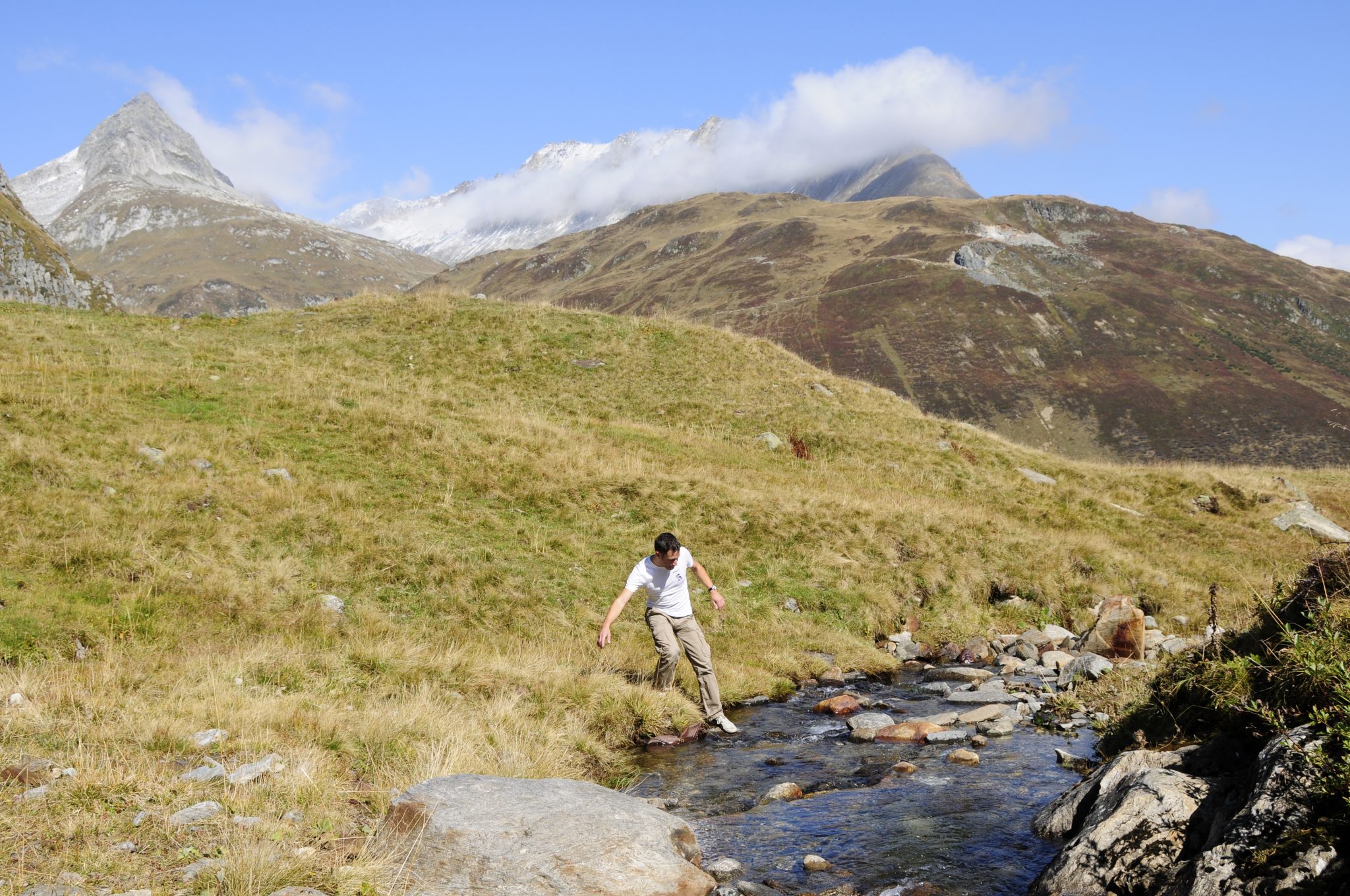
Instagrammable: You jump over the Rhine, which is less than a metre wide at its source in the Tomasee.
Duration of trip: Depends on how much time you have and how often you want to get off along the way. Minimum trip duration is 3 days, two nights. You then have one day for the hike to the source of the Rhine. The short variant with, for example, final destination Koblenz or Mainz also lends itself perfectly to a weekend trip.
Train ticket: An Interrail pass gives you complete flexibility. With one ticket you can travel the entire route, on all trains and without reservations. A single trip Utrecht – Chur is available from 37.90. For more information, see the info box at the bottom of this page.
Planning: With Deutsche Bahn’ affiliate s journey planner affiliate you can plan intermediate stops very conveniently.
A classic since 1827
The journey along the Rhine is one of the classic travel routes in Europe. With the introduction of steamboats (1827) and the train (1856), travel became accessible and affordable for more and more people. By the end of the 19th century, Germany’s Rhine Valley was even one of the most visited travel destinations in the world. In Koblenz, where the Moselle – another beautiful river – flows into the Rhine, Karl Baedeker launched his famous travel guide series in 1828, aimed at the stream of travellers who were already flocking to the beauty of the Rhine by then.
Since 2002, high-speed trains have been racing south from Cologne via the eastern high-speed line, giving travellers a gain of over an hour. In times when speed seems to rule everything, the slower route along the Rhine fell into oblivion. But it is precisely this route that excels in beauty and is so incredibly worthwhile.
Stopovers and sidetracks
If you have more time and want more adventure, do not train directly to the final destination, but stretch the train journey into a real rail trip, making one or more stops along the way. A secret nuclear bunker, an atmospheric wine village, the birthplace of cycling or a hike in the Black Forest… countless places are waiting to be discovered along this train route.
These are our favourite stations, where getting off is worthwhile. Sometimes a short stopover of one or a few hours, sometimes even better with an overnight stay. Or – in the odd case – a local little train that deviates from the main route and takes a sidetrack. A detailed description can be found after the overview.

Stopovers and highlights along the route
All ICEs from the Netherlands and Belgium to Germany travel at 300 kilometres per hour on the high-speed line towards Frankfurt after Cologne. So for the slower route via the Rhine, you always have to change at Cologne Hauptbahnhof. In Cologne, you can choose from the following trains, all of which meander along the Rhine:
1. The direct train to Switzerland, which takes you to Zurich in one trip (travel time 6 hours).
2. Intercity trains to Koblenz, Mannheim or Karlsruhe that make no stops en route.
3. The direct Intercity to Luxembourg, which follows the Moselle after Koblenz and also stops in Cochem.
4. The Regional Express to Koblenz if you want to make intermediate stops at the smaller stations such as Remagen or Andernach.
Cologne Hauptbahnhof station: 500 metres wide Rhine
Luckily, changing trains in Cologne is not a punishment at all. Take your chance to admire the majestic cathedral. Or cross the Hohenzollern Bridge, which almost collapses under the weight of thousands of padlocks. Here you can see the 500-metre-wide Rhine flowing beneath you – always fascinating. Or take a journey through three thousand years of chocolate history at the Chocolate Museum. This sweetest museum in Germany sits like a futuristic ship in the centuries-old Rheinauhafen, reachable after a 20-minute walk along the Rhine bank. The view of the river here is wunderbar. Score another Kölsch, the typical Cologne mini beer, before returning to the station and continuing your train journey.
Remagen station: Famous war bridge
In WWI, the German army command had a railway bridge built over the Rhine at Remagen, with the aim of transporting more equipment and troops westwards. This steel structure was considered one of the most beautiful bridges across the Rhine after the war. At the end of WWII, it was the last bridge still intact. Despite several attempts by the Germans to destroy this crucial crossing, the Americans captured the bridge intact and usable – also known as the Miracle of Remagen. The battle for the bridge was filmed (The bridge at Remagen) and the original remains now house the Friedensmuseum.
Once you have disembarked in Remagen, you can choose to leave the main route and take a little train that follows the river Ahr from Remagen. After only 15 minutes, you’ll reach Ahrweiler station, ideal for the Rotweinwanderweg or a visit to the secret government bunker.
Ahrweiler station: Rotweinwanderweg
The Ahr region is one of the smallest of Germany’s 13 wine regions, but privileged with an ideal Mediterranean microclimate. The 35-kilometre Rotweinwanderweg winds right through this wine paradise (Tal der Roten Traube), where steep hills alternate with mixed forests, idyllic villages, castles and, of course, vineyards.
As you pass through many villages during this hiking trail, you can easily divide the route into several stages. For example, the stretch between Mayschoß station and Rech station, which follows the river valley through a varied landscape of slate, rocks and forests. As soon as you get off at Mayschoß station, you are overwhelmed by breathtaking panoramic views of the valley. On the way, you pass the Weingut Michaelishof and have a view of the Saffenburg, the oldest defensive fortress on the river Ahr. A steep staircase leads you through the vineyards of Recher Herrenberg towards the little station of Rech. Local winemakers regularly give guided tours. You can also roll up your sleeves yourself… the reward – pea soup with a glass of wine – is worth picking.


Ahrweiler station: Super-secret nuclear bunker
At the height of the Cold War, the German government, then based in Bonn, decided to build a super-secret atomic bunker in an old railway tunnel near Ahrweiler. In case of war, this more than 17-kilometre-long, 5-billion-mark costing and food-stuffed bunker was to house 3,000 government officials. Fortunately, the bomb never fell, so you can now marvel at this striking Cold War relic during the 1.5-hour guided tour.
Andernach station: cold water geyser
To see a geyser, you don’t necessarily have to travel to Iceland. In Andernach, just a 10-minute walk from the train station, you’ll find Geysir Andernach, the world’s largest cold-water geyser, with a spouting height of a whopping 60 metres. Unlike hot water geysers, which spout by steam pressure, the Andernach geyser spouts by the pressure of carbon dioxide. Plan a stop of a few hours if you want to brave this cold shower yourself; the geyser is only active every 100 minutes! If you want to escape the ‘gurgle’ and ‘hiss’ of the geyser for a while, you can dive into the surrounding volcanic area and follow one of the many hiking trails or mountain bike trails. The Eifel used to be one big volcanic area.
Koblenz station: Rhine & Moselle
The Intercity makes a stopover in Koblenz, where the Moselle merges into the Rhine. This spot is called Deutsches Eck and has been marked by a colossal monument to German Emperor William I since 1897. Make a pit stop here overlooking the rivers and passing boats. Koblenz is also the place where Karl Baedeker launched his famous travel guide series in 1828, aimed at the masses of travellers who flocked to the beauty of the Rhine even then. Climb the 118-metre-high fortress Ehrenbreitstein across the Rhine for fantastic views over the plateau.

If you have disembarked in Koblenz and are travelling onwards, you can choose from the following trains:
1. The Intercity towards Mannheim, which winds through the Rhine valley without a stop (travel time 1.5 hours).
2. The regional barge to Mainz, which stops in all the villages along the most beautiful part of the Rhine, including St Goar, Bacharach and Oberwesel. In Mainz, you then train on towards Mannheim.
3. A regional barge takes another (wonderful) siding, namely the Moselle valley to Cochem (journey time 35 minutes).
Cochem station: Moselle wines
The Koblenz – Trier railway line, also known as the Moselbahn, is located in the middle of Germany’s most famous wine region and follows the course of the Moselle. This railway proves that trains and wines go extremely well together. From your train window, you see a succession of hills covered with endless rows of vines from which the grapes soak up their daily portion of sunshine. Of course, you can get off as often as you like for a ‘pub crawl’ along different vineyards. Look out especially for Straußwirtschaften. These are wineries where you can not only taste and buy wine, but sometimes also enjoy regional dishes. Towns like Cochem, Pommern and Schweich through which you ride are thoroughly German kitsch, with narrow streets and centuries-old squares that seem straight out of a Brothers Grimm fairy tale. You can also alternate train riding with cycling along the famous (flat) Moselle Cycle Route.

St. Goar station: Rhine valley & Loreley
After Koblenz, the trains meander parallel to the Rhine bank along the most beautiful stretch of the river. The section called the Mittelrhein is particularly impressive and is a UNESCO World Heritage Site. Here you pass narrow valleys and steep slopes full of vineyards, medieval castles and typical German villages. And the Loreley, a 132-metre-high rock on the right bank of the Rhine near Sankt Goarshausen. Legend has it that a singing nymph with golden hair lured boaters, causing them to crash into the rock. Die Loreley is still the most famous work of the poet Heinrich Heine. For those who want to visit the Loreley: there is a ferry from St Goar station to the other side.
If you have the time and want to see more of the special area, take a boat train to Heidelberg. You don’t have to deviate from the route to do so. The train stops at almost all intermediate stations, and so you end up in surprising towns like Bingen, Oberwesel and Bacharach. It’s lovely there. For an overnight stay, hotel Papa Rhein in Bingen, with wide views over the river, is an atmospheric recommendation.

Mainz station: Also on the route is Mainz, on the left bank of the Rhine opposite where the Main River flows into the Rhine. It is the official wine capital of Germany and lends itself perfectly to a longer stopover. From the station, you can walk in ten minutes to the pretty Altstadt with its traditional half-timbered houses. There, on Liebfrauenplatz, is the Gutenberg Museum, housed in the 15th-century home of Johannes Gutenberg, the inventor of book printing in Europe. The treasury houses two copies of the world-famous bibles, which Gutenberg printed in Mainz between 1452 and 1455. They can be viewed behind glass.
But of course, the city centre is mainly dominated by a glass of good German wine. Besides the famous wine restaurant Haus des Deutschen Weines, you will find cosy wine bars everywhere. Locals spend hours there chatting with each other, obviously with the necessary good wine from the area. Order a portion of Spundekäs (cream cheese with cottage cheese, topped with pretzels or bread) and you are almost a local yourself.
Mannheim station: Last natural floodplain
In railway junction Mannheim, about a 30-minute walk from the station (or a short ride on tram 3 towards Neckarau) you will find the Waldpark with adjacent the Reißinsel. This city oasis is not only a haven for Mannheim’s inhabitants, but also for many animals that have found refuge in this nature. Largely untouched for decades, the Reißinsel is one of the last naturally occurring floodplains of the Rhine. Dive into the woods, follow the more than 4-kilometre-long path and land in a lush green meadow with gnarled fruit trees. The fruit knots are among the largest orchard meadows in the Upper Rhine plain.

Straight south? Then you’ll miss Heidelberg!
The quickest option to the south is the direct connection from Mainz to Basel, where you change trains towards Schaffhausen (Rheinfall). While this route runs parallel to the Rhine, it no longer runs along its banks. Again, if you have more time, a more attractive alternative beckons, with an overnight stay in one of our favourite cities, Heidelberg, and a diversion through the Black Forest to the Rhine Falls.
Located on the Neckar River, Heidelberg is strangely relatively unknown. With its combination of medieval history, high-class culture, picture-perfect nature and a vibrant student life (a quarter of its inhabitants study!), the city’s popularity has grown rapidly. This is also thanks to the pristine state of the beautiful Altstadt. Indeed, Heidelberg was one of the few larger German cities to survive WWII without damage. Historic buildings can therefore be admired in their original state. In summer, culture lovers enjoy the many theatre and music festivals around Heidelberg Castle, literally the epitome of romance.
Philosophically inclined? Then follow in the footsteps of poets, scholars and academics. Like Goethe, who is said to have regularly mused along the Philosophenweg on the north side of the Neckar. The view of the Altstadt and the dramatic castle ruins from here is breathtaking.


From Heidelberg, there are several direct trains per hour to Karlsruhe (30 – 45 minutes)
Karlsruhe station: Through the Black Forest
Start of the famous Black Forest Railway. This traverses, as its name suggests, part of the immense Black Forest, from Karlsruhe to Constance to be precise. Restful forests, sunny vineyards, steep slopes and nostalgic farms characterise this stretch. When you board the Schwarzwaldbahn, you choose one of the most picturesque railways in Europe. The train has only just set off, or in the Rhine Valley you are already treated to fantastic views; to the east, the northern spur of the Black Forest stretches out before you, and to the west you can see the Vosges Mountains in France when the weather is nice.


After Baden Baden, Deutsche Bahn’s little red trains merge into the rolling densely forested hills, towards the Swiss border. After an hour of trains, you can stop in Gengenbach, a charming town with many half-timbered houses, including the more than 200-year-old town hall. Walk through medieval streets and past centuries-old towers and gates and you will soon imagine yourself in a fairy tale book. In Triberg (centre of cuckoo clock production since 1824), you’ll find not only thousands of cuckoo clocks but also Germany’s highest waterfall. From the station, a 4-hour hiking trail (20 km) takes you past the 163-metre-high waterfall. The highlight of the Schwarzwaldbahn comes a few kilometres after Triberg, when the train starts its descent to the origin of the Danube. The train then winds along Europe’s most sung about river, here nothing more than a narrow stream. The impressive castles, vast fields and picturesque towns are guaranteed to keep you glued to the window until Lake Constance finally announces the end of your journey. Don’t stay until the end point, however, but get off the train half an hour earlier in Singen. From there, the connection leaves for the Swiss town of Schaffhausen where a huge spectacle awaits you: the mighty Rhine Falls.
If you travel further to the Rhine Falls, leave the Schwarzwaldbahn at Singen station and transfer here to the regional train to Schaffhausen (travel time 25 minutes).

Schaffhausen station: Europe’s biggest waterfall
Few waterfalls have their own station. The Rhine Falls has two: Neuhausen Rheinfall on the Schaffhausen-Zurich line, and the smaller Neuhausen Schloß Laufen am Rheinfall on the Schaffhausen-Winterthur connection. At Neuhausen Schaffhausen, the river plunges from the Rheinfall, forming Europe’s largest waterfall. From a distance, the 23-metre-high fall does not seem too bad in terms of height, but appearances can be deceiving. Those who manage to get close, by boat or after a short walk from Neuhausen Rheinfall station, literally feel the power of 600 thousand litres of water per second thundering over the rocks. Even from your window on the train to Zurich (look for a seat on the left side!) you have a phenomenal view of the natural spectacle.


From Schaffhausen station you travel to Chur in just under two hours, via an easy change at Zurich Hauptbahnhof. The trains heading south travel at breakneck speed along the shores of Lake Zurich, with stunning views of the lake and snow-capped mountain peaks in the background. Like almost everywhere in Switzerland, this route is a feast for the eyes and a taste of what awaits you at the end of this long journey along the Rhine.

From Schaffhausen station, a direct train goes twice an hour to Zurich (travel time 40 min), where you can hop on a train to Chur every hour (travel time 1 hour).
Zurich Hauptbahnhof station: Uetliberg
Zurich is perhaps Switzerland’s best-kept secret and also an ideal stopover or overnight spot. The moment the sun disappears behind the Alps in the west, the boulevards turn into one big entertainment centre. Zurich’s green oasis is called the Sihlwald. For the best views of the city, catch the train towards Uetliberg (20 min). Although this ‘mountain dwarf’ is only just under 900 metres high, the 30-metre-high viewing tower offers fantastic views of Zurich and its surroundings from the peak.
Chur station: 5,000 years of history
From Chur station, you can hop on the local red Rhaetian Railway train every hour, which travels along the Hinterrhein and Vorderrhein rivers through spectacular mountain scenery to Disentis/Mustér station. There you change trains to station Oberalppass, final destination of this train journey (total travel time Chur – Oberalppass is 2 hours). At the red lighthouse, your hike to the source of the Rhine starts .
Reichenau station: the surrealism of the Rhine Gorge
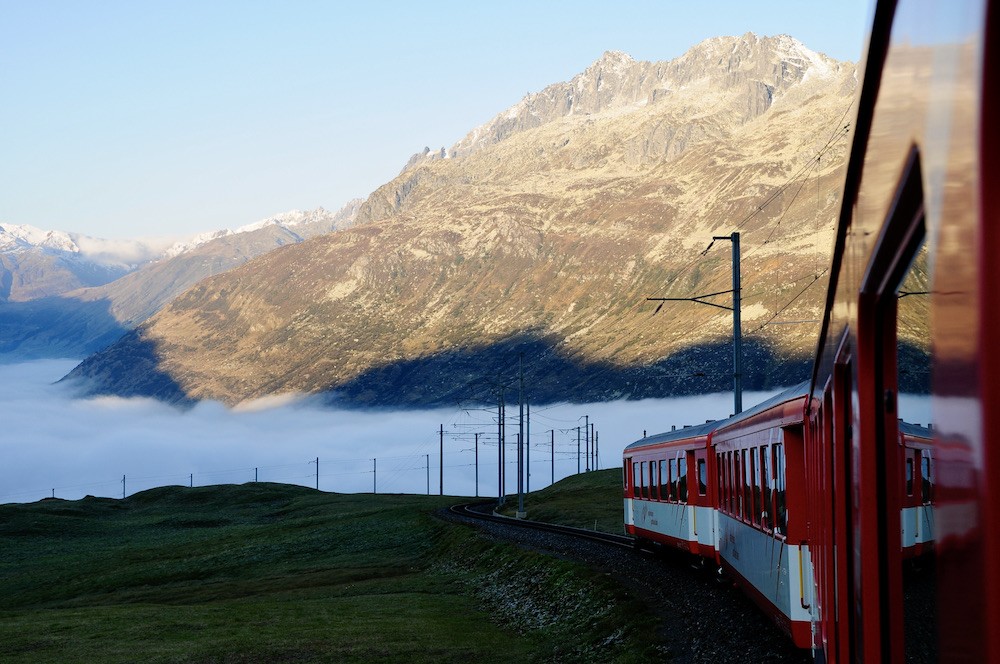
At Chur station, the Rhaetian Railway’s red barge is waiting every hour, which tumbles along the Hinterrhein and Vorderrhein through spectacular mountain scenery to Disentis/Mustér station. There you transfer to the Matterhorn Gotthardbahn’s red and white excursion train for the ride to Oberalppass station. This 2044-metre-high pass forms the border between the Swiss cantons of Graubünden (to the east) and Uri (to the west). In the Middle Ages, farmers followed the road from Disentis to Andermatt to reach the pig and goat markets in Uri and Ticino.
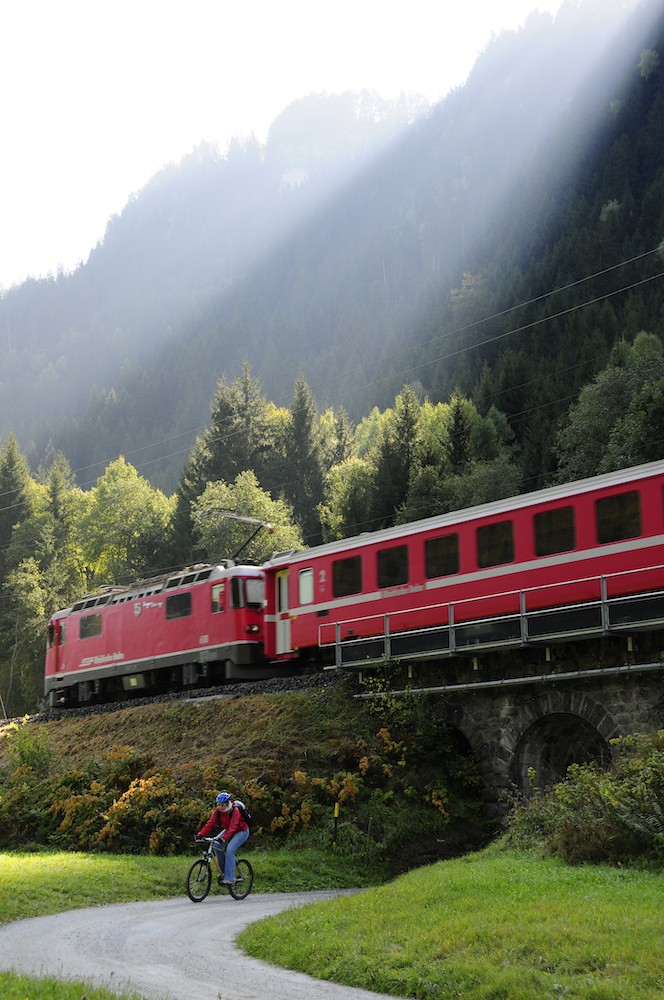
On the route between Reichenau and Ilanz is perhaps the most impressive gorge in all of Switzerland. Not for nothing is it called the ‘Swiss Grand Canyon’. Bizarre rock formations up to 400 metres high create a surreal atmosphere in the right light. The Rhine Gorge – Rheinschlucht in German – is also a UNESCO World Heritage Site. It winds through an imposing landscape carved by the Rhine over thousands of years. Along the way, canoeists brave the fast-flowing water. Sunbeams fall like a spotlight on the little red-and-white train as it races past steep precipices.
Sports enthusiasts can rent a bike in Chur, Reichenau or Disentis, for example, and follow part of the Rhine Cycle Route. A varied bike ride with the occasional tough climb. But with a big advantage: if you get tired of cycling, just jump on the train with your bike! You can also take the train to the Oberalppass, so most of the route is downhill. Rhaetian Railway’s red trains stop everywhere along the route.

Oberalppass station: hike to the source
The Oberalppass (2044 m) connects the Swiss cantons of Graubünden and Uri. In the Middle Ages, farmers followed the road from Disentis to Andermatt to reach the pig and goat markets in Uri and Ticino. When you get off the train here, you are welcomed by a bright red lighthouse. This replica of a classic Rotterdam lighthouse is the highest lighthouse in the world and links to the other end of the Rhine in the Netherlands.
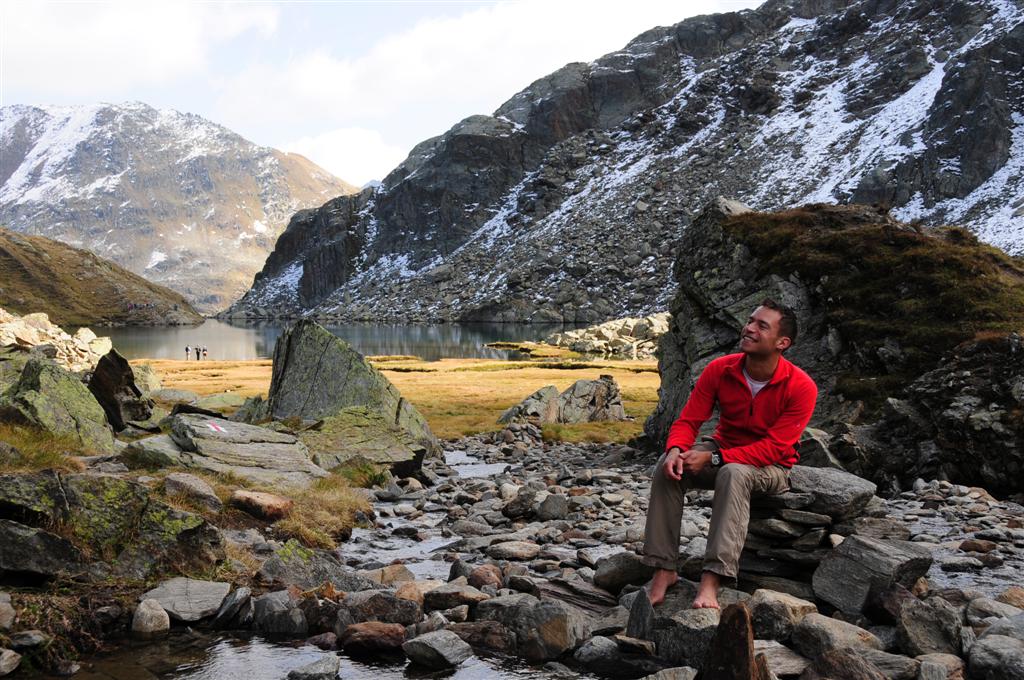
A narrow path leads from the Oberalppass in about two hours to a mysterious, dark blue lake at 2345 metres: the beautiful Tomasee, officially the source of the Rhine. Countless babbling brooks cross the path and together form the Vorderrhein, the longest of the two source rivers of the Rhine. It is hard to imagine this same water flowing into the North Sea near Rotterdam. Here it is so pure, you can drink it straight from the stream.
An intense silence surrounds the Tomasee, overlooking snow-capped mountain peaks. A little further on, Vorderrhein and Hinterrhein come together to continue flowing as the Rhine. By then, the river is tens of metres wide. Here it is less than a mere metre. A magical place, then, that invites reflection. You are at the origin of one of Europe’s most important lifelines. Climate scientists see the future of the Rhine as bleak. With the disappearance of glaciers, increasing water pollution and unbridled building on its banks, the natural course of the river is in danger. And with it, the drinking water supply for 30 million Europeans.
Now that you have reached your destination, just enjoy the feeling of crossing this mighty river with a single step. And don’t forget to fill your drinking bottle with pure Rhine water before starting the walk back. Now you still can.