
In Switzerland, travelling by public transport is often not a matter of ‘getting from A to B’, but an experience in itself. This is certainly true in the canton of Bern. Although most locals use the train, bus or cable car to get to their destination, in this region it is at least as tempting to just stay put. Because along the way, a succession of unforgettable views, shimmering lakes, steep mountain sides, charming alpine villages and snow-capped peaks that look almost otherworldly unfolds.
What makes it even more special: in Switzerland, almost everything is part of public transport. From world-famous mountain trains to local post buses winding their way through valleys, and from modern trams to historic rack railways and canal boats. The network is flawlessly coordinated and designed for enjoyment. So you don’t need to be a mountaineer to sample the mountain world – a train ticket or Rail Pass will do.
In this blog, we share 7 favourite spots in the Bern region where the views along the way are at least as memorable as the destination itself. Get on board!
1. Arrival by train in Bern – over the Aare towards Altstadt
Even before you enter Bern station, you are treated to a stunning view: the train crosses the Aare via a high bridge, with the medieval Altstadt on the left and, on clear days, even the first contours of the Bernese Alps beyond. And below you flows the deep blue Aare. An impressive entrance.

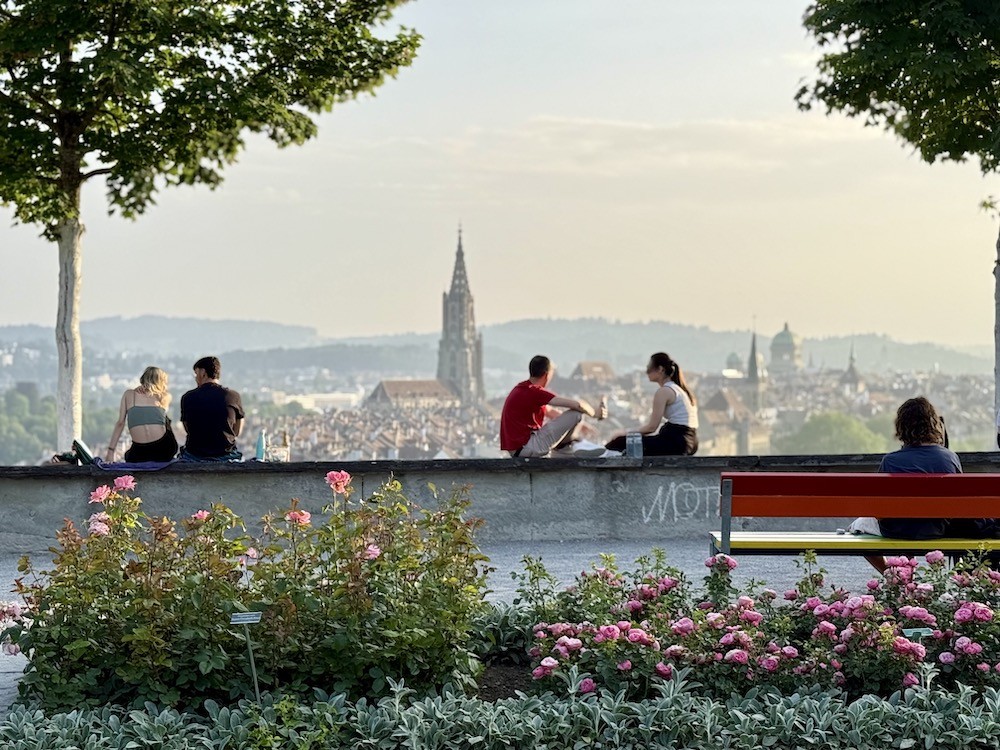
2. Bus 10 to Rosengarten – views over Bern
A short ride on bus line 10 from Bern station to the Rosengarten stop takes you to one of the most beautiful viewpoints over the city. Even the bus ride itself is pure enjoyment, as you meander through the Altstadt, passing the Zytglogge and crossing the Aare, among others. From the Rosengarten, you look out over the roofs of the Altstadt, the winding Aare and, if you are lucky, the white peaks of Eiger, Mönch and Jungfrau on the horizon.
3. Train from Bern to Interlaken – via Lake Thun
The journey between Bern and Interlaken Ost is a feast for the eyes, especially the stretch just after Spiez. On the left side of the train, a picture-perfect view unfolds over the turquoise waters of Lake Thun, with countless (famous) mountain peaks on the horizon — and even the highest railway station in Europe visible to the naked eye. A window seat is priceless on this stretch. The short ride from Interlaken Ost to Brienz, along the northern shore of Lake Brienz, is pure theatre.

4. Local train Zweisimmen-Lenk – along the river Simme
From Zweisimmen station, this regional train meanders leisurely along the Simme river in just under half an hour to its terminus in the valley, Lenk. Looking south-east, you will catch a glimpse of the imposing mountainside at the end of the Simmental, including the 3244-metre-high Wildstrubel. For even better views, walk from the little station in 10 minutes to the Betelberg Bergbahnen, where gondolas take you in about 20 minutes to mountain station Leiterli, starting point of several hikes.

5. The Lötschberg railway line – from Bern to Brig
The more than 100-year-old Lötschberg railway line from Bern to Brig is among the most impressive rail routes in Switzerland. This historic mountain route runs via Spiez, Frutigen and Kandersteg and is considered one of the most daring masterpieces of Swiss railway history. The line excels in ingenious structures, such as the imposing Kander Viaduct near Frutigen and the spectacular hairpin bends around Felsenburg Castle in the picturesque Kander Valley.
Besides technical feats, there are also phenomenal views along the way. Riding through green valleys, past mountain streams and deep gorges, a panoramic mountain landscape unfolds with ever-changing vistas. Between Kandersteg and Goppenstein, the train crosses the historic Lötschberg Tunnel, after which you descend towards Valais. The combination of nature and technology makes this ride an unforgettable slow travel experience through the heart of the Alps. Want a little ‘taste’? Buses leave every hour from Spiez station to Brig, via Frutigen and Kandersteg.

6. Wengernalpbahn – from Lauterbrunnen or Grindelwald to Kleine Scheidegg
The Wengernalpbahn is not just any mountain railway – it is the longest rack railway in the world. Over a stretch of over 19 kilometres, this iconic train connects the villages of Grindelwald, Wengen and Lauterbrunnen with the Kleine Scheidegg mountain station, at a whopping 2,061 metres above sea level.
The ride is a spectacular experience: as the train climbs steadily uphill, a panorama of snow-capped peaks, green alpine meadows and waterfalls unfolds. The route between Lauterbrunnen and car-free Wengen is particularly popular – not only with travellers, but also essential for supplying the village.
In addition, the WAB is the main feeder line for visitors to the famous Jungfraubahn. Every year, the Wengernalpbahn transports more than 1.8 million people to Kleine Scheidegg, the starting point of the climb to the “Top of Europe”.

7. From Lauterbrunnen to Mürren – via Grütschalp
One of our absolute personal highlights is the journey from Lauterbrunnen station to the car-free village of Mürren at an altitude of 1638 metres. This journey starts right next to the station with a steep cable car to Grütschalp, from where you have a great view of Lauterbrunnen and the famous Staubbachfall. At Grütschalp station, board a panoramic cable car towards Winteregg and Mürren (sit on the left in driving direction here!). Immediately after departure, you’ll have stunning views over the Lauterbrunnen Valley and the famous mountain trio of Eiger, Mönch and Jungfrau. A short ride of just 20 minutes, but world-class. In the cable car, your Interrail Pass is also valid.

Train and public transport connections for all described routes can be found in the SBB travel planner (Swiss Railways).

GdIVkbgJhkieHhjK
BuHWIcNWsRisINKvgi
BYGelJKbXtzfrQsAElTfjt
HgzyzGVmnJniTptCqk