

Train stations are more than just places to get on a train. They are starting and ending points of journeys, meeting places full of stories, and sometimes the platform offers unforgettable views. In the Bern region, you will find many unusual variants – sometimes as small and charming as a chalet, sometimes spectacularly hidden in a mountainside, and of course the highest station in all of Europe.
Some of these stations are still in full use, others have been given a second life as museums, visitor centres or community places. What they have in common? A special story, striking architecture or a surprising history. We collected ten of these characterful station buildings in the Bern region – places you will want to stop for a moment before continuing your journey.
- 1. Bern Matte station – hidden icon in the heart of Bern
- 2. Gurten Kulm station – gateway to Bern's green lookout point
- 3. Zweisimmen station – where mountain lines meet
- 4. Former Frutigen railway station – mini railway museum
- 5. Bern Weissenbühl station – 100 years back in time
- 6. Station Blausee-Mitholz
- 7. Eiger Glacier station – between a valley and high mountains
- 8. Eismeer station – station in a mountainside
- 9. Jungfraujoch station – Europe's highest train station
- 10. Station Lenk: end of the line
1. Bern Matte station – hidden icon in the heart of Bern
In a city where medieval charm meets modern technology seamlessly, the Mattelift has been an indispensable part of the Bern cityscape for more than 125 years. This elegant steel lift connects the ‘valley station’ Bern Matte to the 31.5-metre-high Bern Münsterplattform in the historic city centre. No ordinary lift, and an oddity but a Swiss uniqueness: manually operated by real conductors – the so-called Liftgirls and Liftboys.
Opened in 1897, the Mattelift was Bern’s first public lift. It made daily life much easier for the residents of the Mattel district, who until then could only reach the upper town by steep stairs or detours. Originally, the lift was powered by water power: the weight of a water-filled tank under the cabin provided the drive. It was only in 1973 that the lift was converted to electric operation. This makes it a rare example of early sustainable technology.
Meanwhile, the Mattelift transports more than 750 passengers daily – residents, schoolchildren, tourists – all equally enthusiastic about this charming journey of just a few dozen metres. Moreover, since 2020, women have been operating the lift, adding a new chapter to this living piece of heritage. The Mattelift is free of charge with your Bern Ticket.

2. Gurten Kulm station – gateway to Bern’s green lookout point
A few minutes outside the centre of Bern, a completely different world awaits: the Gurten, the city’s home mountain. With the iconic Gurtenbahn, a charming cogwheel railway that has been climbing the steep slope since 1899, you travel in just five minutes from Gurten Talstation station to the high-altitude Gurten Kulm. At the top, you get off at a small mountain station with grand views: over Bern, the Aare and, on a clear day, up to famous Alpine peaks.
The Gurten is more than views. You can go hiking, picnicking, mountain biking or even sledding in winter. For families, there is a large playground with a mini train and, of course, a restaurant. The ride on the Gurtenbahn is free with your Bern Ticket.

3. Zweisimmen station – where mountain lines meet
In the picturesque village of Zweisimmen, on the edge of the Simmental, there is a striking station building that immediately catches the eye: a charming wooden chalet with gables and bell tower – almost as if it had stepped out of a Swiss postcard. The little building dates from 1906 and combines classic mountain style with historical value. It is included in the cantonal inventory of protected cultural objects – a recognition of its architectural and functional significance
But Zweisimmen is more than photogenic: this station is an important junction between the Montreux-Berner Oberland Bahn (MOB) and the BLS railway towards Spiez and Bern. Here you literally switch from German- to French-speaking Switzerland. The village itself is a lovely place to slow down. Stroll through the rural surroundings, take a cable car to the mountain world around Rinderberg, or enjoy local delicacies on a sunny terrace.
Zweisimmen is also the ‘pivot point’ of the iconic GoldenPass Line, which winds from Interlaken via Zweisimmen, Gstaad and Montreux to Lake Geneva. Since 2022, the panorama trains have been running with variable gauge, allowing you to travel from Interlaken to Montreux without changing trains.

4. Former Frutigen railway station – mini railway museum
The former Frutigen station, built between 1901 and 1913, underwent a careful restoration in 2017 and has since been transformed into the BLS Besucherzentrum. On the outside, it exudes the classic architecture of the Lötschberg construction period. Inside, you will find originally restored waiting rooms and and a mini-museum on the history of the Lötschberg line, with a model, film footage and historical objects.

5. Bern Weissenbühl station – 100 years back in time
Anyone passing the charming Bern Weissenbühl railway station might not suspect that world history was once made here. On 26 June 1956, Indonesian President Sukarno arrived by special train at this modest district station as part of a diplomatic tour of Europe as part of the global decolonisation wave. He was personally welcomed there by Federal Councillor Markus Feldmann – a symbolic moment that briefly turned this quiet stop into an international stage.
The station itself opened back in 1901 as part of the then-new Gürbetalbahn railway between Bern and Thun. The grand opening was celebrated with a locomotive adorned with flowers and many local spectators. The original station building is still there, in recognisable chalet style, and is a nostalgic eye-catcher in the neighbourhood. It now houses a BLS Travel Centre.
Just outside the station is a surprising work of art: the sculpture Frühling (Spring) by Bern artist Walter Schnegg, placed in 1951. An understated tribute to the season.

6. Station Blausee-Mitholz
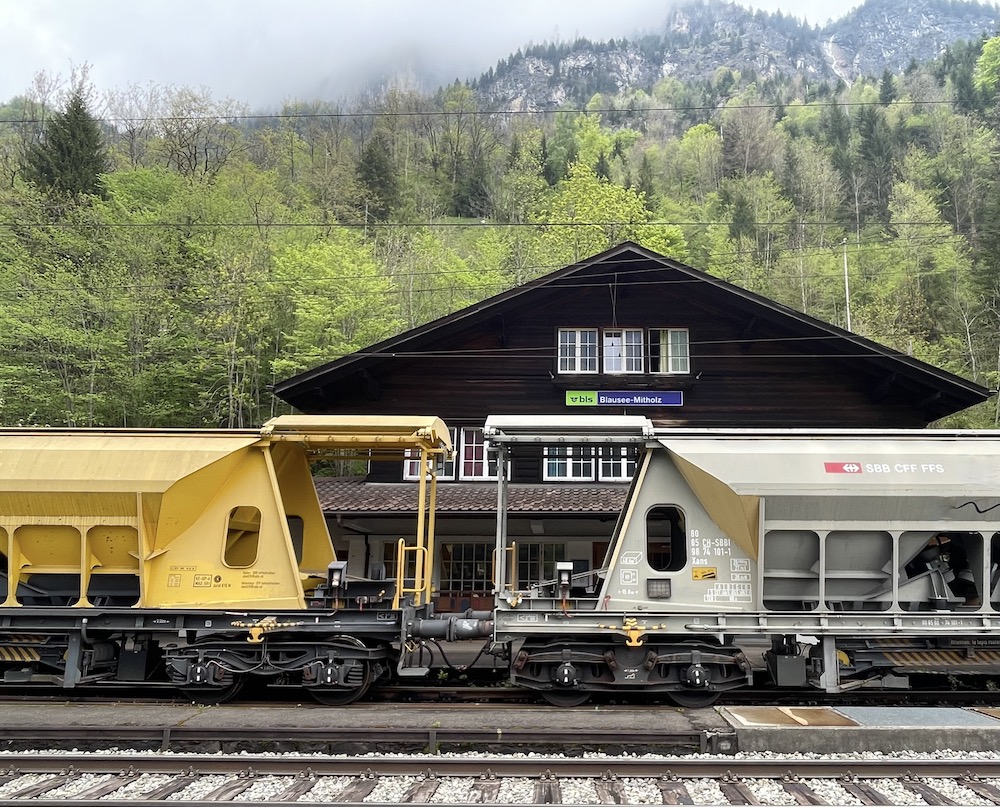
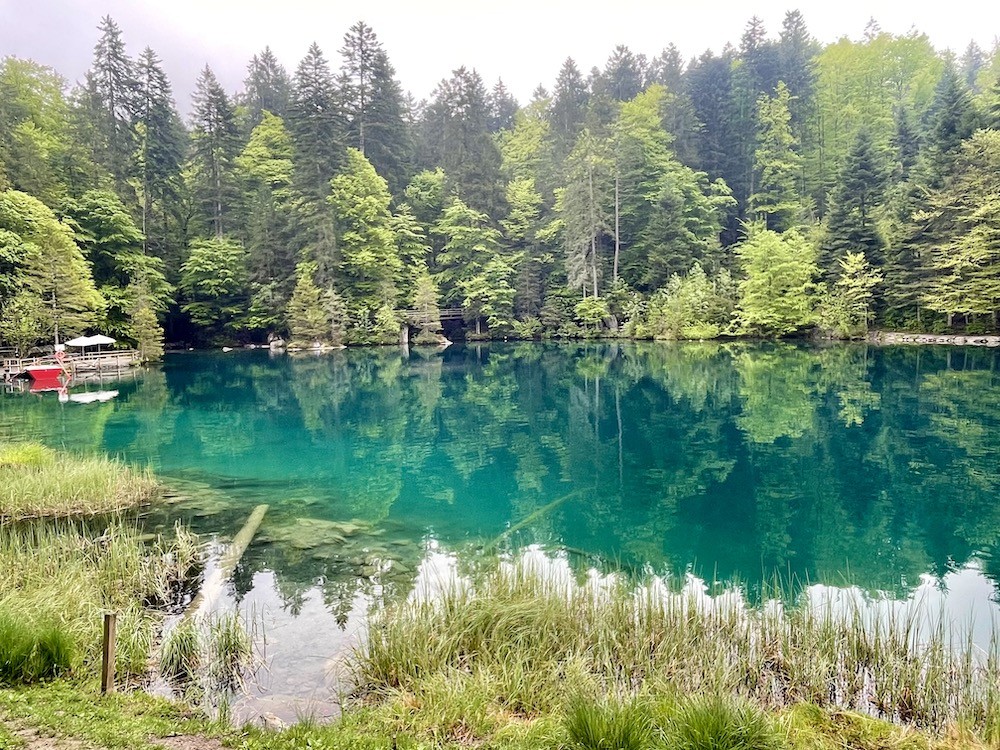
On the Lötschberg line, between Frutigen and Kandersteg, lies the charming Blausee-Mitholz station. Although today it barely serves train traffic and has no manned functions, the little building is a wonderful example of typical BLS architecture from the early 20th century. The station building, in chalet style with overhanging roofs and wooden details, is largely preserved in its original state. Its name refers to the nearby natural jewel Blausee, within walking distance of the station. This makes it a popular getaway destination for hikers, nature lovers and railway historians. Although the train still stops here on request (stop function), the station mainly exudes tranquillity, simplicity and nostalgia – as if time has stood still there.
7. Eiger Glacier station – between a valley and high mountains
Station Eiger Glacier is located at 2,320 metres at the foot of the world-famous Eiger North Face. It is the last transfer point before you ascend through the mountains by rack railway to the Jungfraujoch. The station has been accessible not only by train since 2020, but also via the spectacular Eiger Express cable car, which glides you from Grindelwald Terminal to Eiger Glacier in 15 minutes, with unparalleled views of the Eiger, Mönch and Jungfrau along the way.
This is where technology and nature come together. On one side, the Jungfraubahn departs, diving deep into the mountain towards Europe’s highest stations; on the other, an alpine landscape unfolds where hikers, skiers and mountaineers can enjoy themselves.


8. Eismeer station – station in a mountainside
At an altitude of 3,160 metres, deep in the Eiger, lies the extraordinary Eismeer station, on the route from Eigergletscher station to Jungfraujoch. Carved into the mountainside, this underground station offers breathtaking views of the Eismeer glacier through large panoramic windows. The train makes a short stop here during the climb up, allowing travellers to admire the white, otherworldly landscape. Eismeer Station is not only a technical masterpiece from the early 20th century, but also a unique resting point in the middle of Switzerland’s alpine heartland – a place where you may literally pause for a moment in the interior of the Alps.

9. Jungfraujoch station – Europe’s highest train station
At a breathtaking 3,454 metres above sea level is Jungfraujoch station – Europe’s highest train station. It is the spectacular terminus of the legendary Jungfraubahn, which cuts across the Eiger and Mönch. Since 1912, this cogwheel railway has been taking passengers to the ‘Top of Europe’ platform, where a world of eternal snow, glaciers and crystal-clear mountain air awaits.
From the station, you can access the impressive Sphinx Observatory, the Ice Cave, a panoramic platform overlooking the Aletsch Glacier and even a year-round snow park. The combination of extreme height difference, technical ingenuity and unparalleled views makes this place one of the most special destinations in Europe.

10. Station Lenk: end of the line
Anyone travelling by train deep into the Simmental will eventually arrive at a place where the rails end but the mountains begin: Lenk im Simmental. This charming terminus lies at the end of the railway line that follows the valley from Zweisimmen – and is literally the ‘end of the line’. But for hikers, mountain lovers and peace-seekers, it actually feels like a starting point.
The station building itself is still largely in its original state and exudes classic Swiss mountain style: wood, sloping roofs and an inviting sense of timelessness. The station building houses a surprisingly good coffee shop where you can let your journey sink in for a while with mountain views – or recharge for a day in nature. Numerous hiking trails depart from Lenk towards the Wildstrubel massif and the Simmenfälle.


Leave a Comment